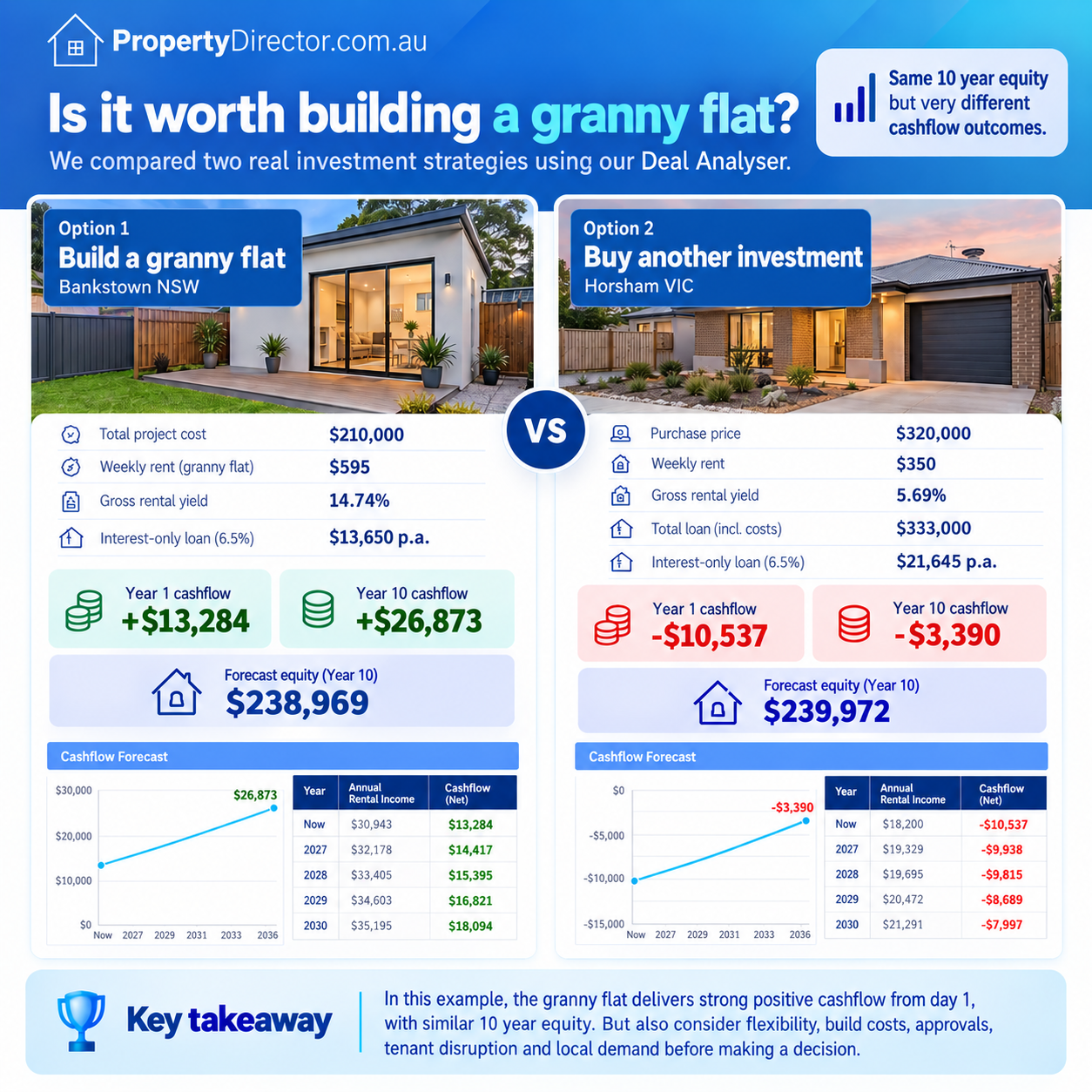
One question we’ve heard increasingly from property investors is: with construction costs so much higher today, is building a granny flat still worth it?
Around 10 years ago, you could build a good-quality brick granny flat in Sydney for approximately $110,000-$130,000. Today, a comparable build can cost around $210,000 or more.
So, let’s compare two real-world investment strategies:
Option 1: Build a granny flat on an existing investment property in Bankstown, Sydney.
Option 2: Leave the existing property and pool untouched, and instead purchase another investment property in Horsham, Victoria.
OPTION 1 - BUILD THE GRANNY FLAT
This example is based on an actual investor who kept construction costs relatively efficient.
* Total project cost: $210,000, including removal of the existing swimming pool
* Weekly rent achieved: $595
* Gross rental yield on project cost: 14.74%
* Entire $210,000 funded using equity at 6.5% interest-only
* Annual interest: $13,650
* Property management: 6%
* Maintenance: $350 p.a.
* Water: $1,000 p.a.
* Insurance: $600 p.a.
* Additional council/bin costs: $200 p.a.
Year 1 cashflow: +$13,284
Year 10 cashflow: +$26,873
Forecast equity generated by Year 10: $238,969
The forecast assumes the overall property, including the granny flat, follows the historical long-term house growth assumptions used for Bankstown.
OPTION 2 - BUY ANOTHER INVESTMENT PROPERTY
Instead, let's assume the investor purchases a house in Horsham, Victoria:
• Purchase price: $320,000
• Weekly rent: $350
• Gross rental yield: 5.69%
• Total borrowing including purchase costs: $333,000
• Interest-only rate: 6.5%
• Annual interest: $21,645
• Council/water rates: $3,300 p.a.
• Property management: 6%
• Maintenance: $1,000 p.a.
• Insurance: $1,700 p.a.
Year 1 cashflow: -$10,537
Year 10 cashflow: -$3,390
Forecast equity by Year 10: $239,972
Interestingly, the forecast equity after 10 years is almost identical - but the cashflow outcomes are very different.
In this particular example, the granny flat produces strong positive cashflow from the beginning, while requiring substantially less additional borrowing.
But that doesn't automatically make granny flats the right choice for everyone.
A separate investment property provides greater flexibility - you can potentially sell it independently when circumstances change. A granny flat generally forms part of the existing property, so realising its capital value usually means selling the entire property.
There are other factors to consider too: construction costs, council/planning requirements, build time, dealing with builders, possible disruption to existing tenants, potential rent reductions during construction, reduced privacy and whether granny flats are actually in strong rental demand in that particular area.
The lesson? Don't just ask whether granny flats are a good investment. Run the numbers for your particular property and compare them against what else you could do with the same capital.
Below is a side-by-side comparison we've modelled using the PropertyDirector Deal Analyser.