One of the most overlooked concepts in property investing is the power of compounding growth over time.
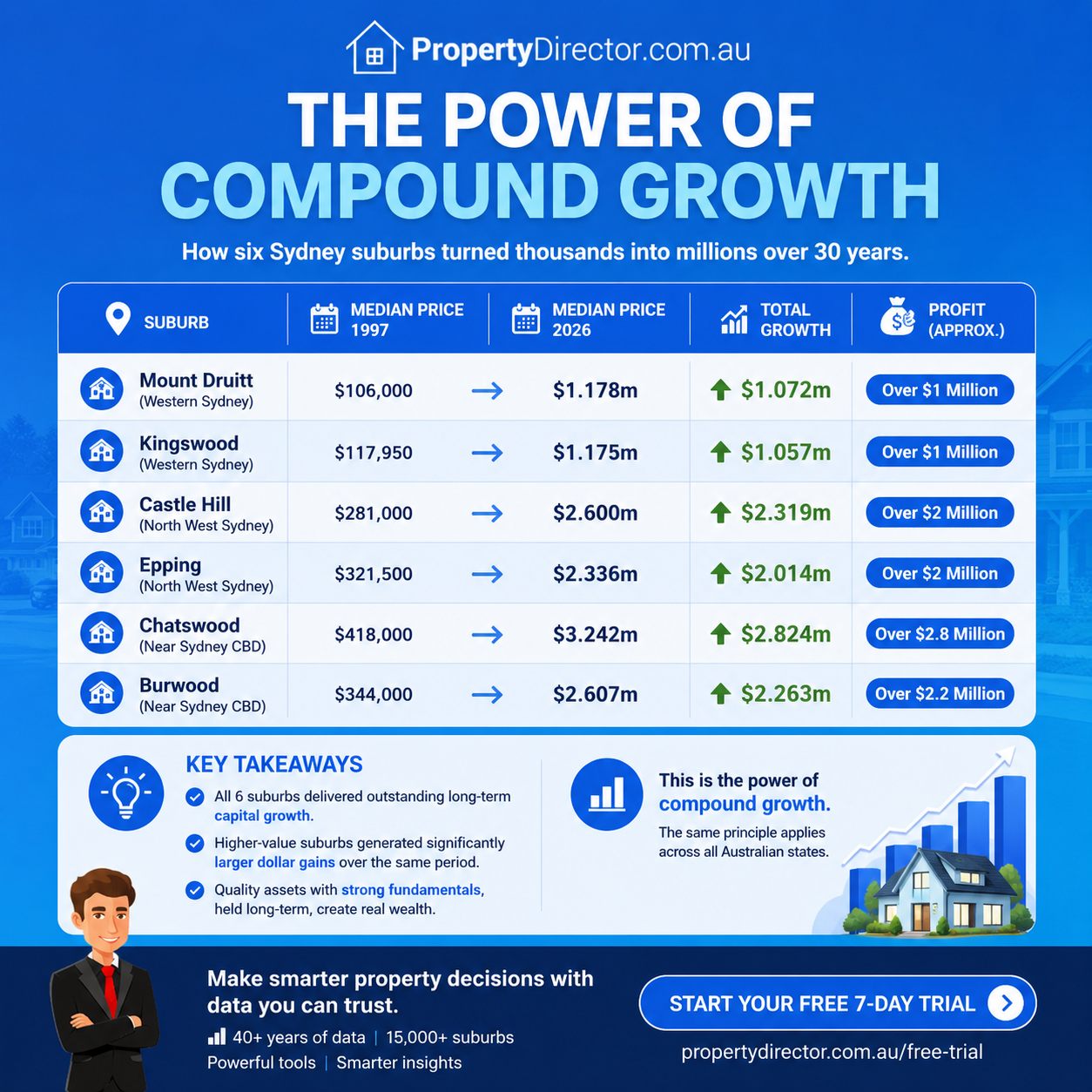
To demonstrate this, we analysed six Sydney suburbs across different price brackets and locations, comparing their median house prices from 1997 to 2026.
The results were remarkable.
* Mount Druitt and Kingswood, with median prices around $110,000 in 1997, each delivered more than $1 million in capital growth.
* Castle Hill and Epping, with median prices around $300,000 in 1997, each delivered more than $2 million in capital growth.
* Chatswood and Burwood, with median prices around $375,000–$420,000 in 1997, generated more than $2.2 million to $2.8 million in capital growth.
The key takeaway?
While all six suburbs delivered exceptional long-term results, the higher-value suburbs generated substantially larger dollar gains over the same period.
This highlights an important investment principle: when supported by strong fundamentals and held over the long term, a higher-quality asset can often outperform simply buying the cheapest property available.
Of course, affordability, risk tolerance and borrowing capacity should always be considered. However, these examples demonstrate why many successful investors focus on asset quality and long-term growth potential rather than entry price alone.
The same principle applies across property markets throughout Australia.
At PropertyDirector, you can analyse over 40 years of historical growth data across more than 15,000 Australian suburbs, helping you identify the locations with the strongest long-term investment fundamentals.
Start your free 7-day trial today: