Talking about tax change impacts on property investing isn’t always the most exciting conversation… especially when tax time rolls around and the accountants start asking questions.
But understanding how changes to property tax regulations impact your bottom line is essential as a property investor.
The proposed Capital Gains Tax (CGT) reforms from the Labor Government could have significant implications for investors, so let’s break it down in a simple way using a “before vs after” example.
Here’s a simplified overview of the proposed changes:
* The current 50% CGT discount available to investors who hold a property for more than 12 months would no longer apply.
* Instead, a new system would apply a minimum 30% tax rate on capital gains, while also factoring in inflation since the property was originally purchased. Investors in higher tax brackets may pay more.
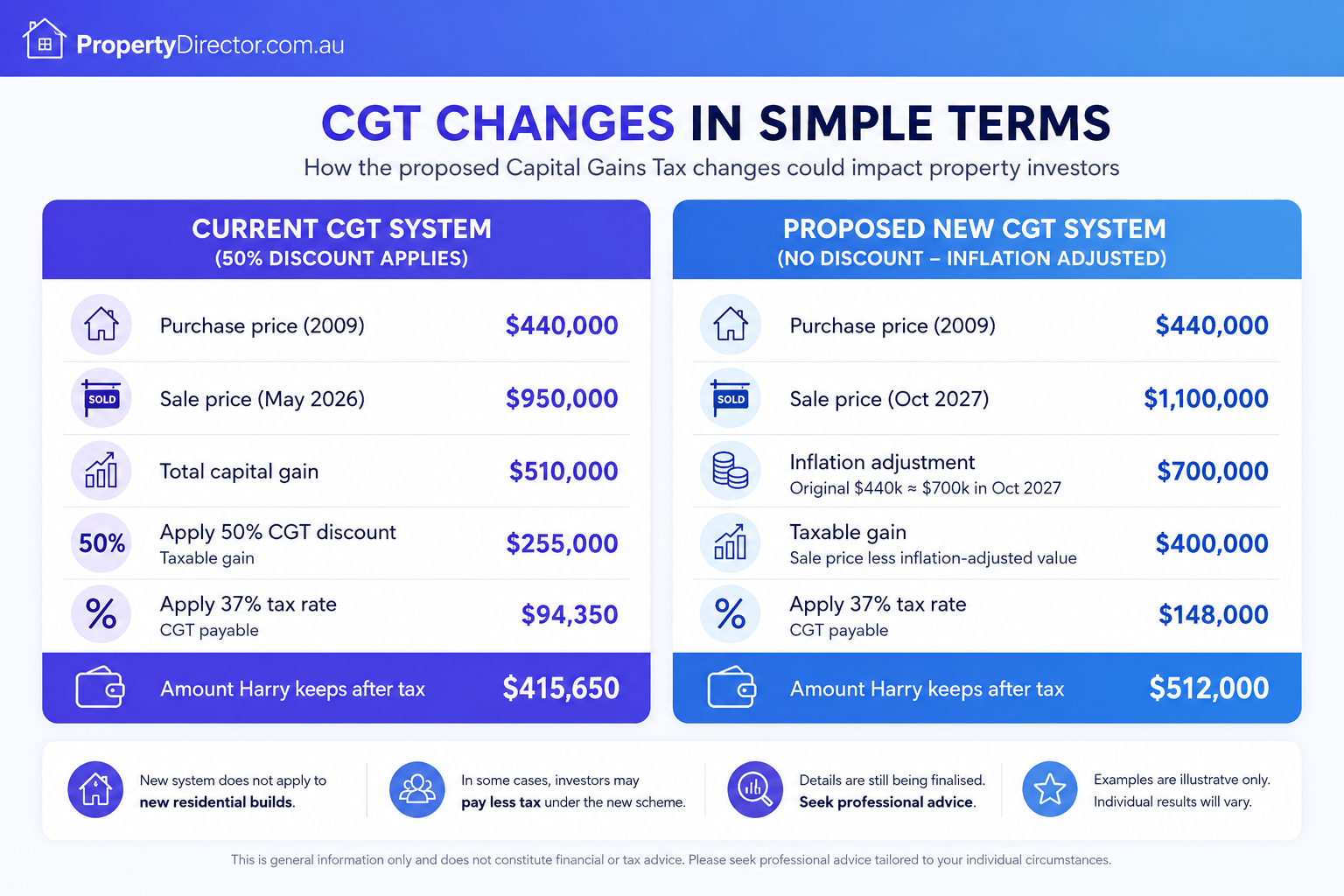
Example under the CURRENT CGT system:
* Harry purchased an investment property in 2009 for $440,000 and sells it in May 2026 for $950,000.
* His total capital gain is $510,000.
* Under the current rules, Harry receives the 50% CGT discount, reducing the taxable gain to $255,000.
* Applying Harry’s 37% tax rate results in CGT payable of $94,350.
* After tax, Harry retains approximately $415,650 from the gain.
Example under the PROPOSED NEW CGT system:
* Harry purchases an investment property for $440,000 in 2009 and sells it in October 2027 for $1,100,000.
* His total capital gain is $660,000.
* Under the proposed model, inflation is taken into account. Let’s assume the original $440,000 purchase price is adjusted to an inflation-equivalent value of $700,000 by 2027.
* The taxable gain is therefore reduced to $400,000 ($1.1m sale price less the inflation-adjusted value).
* Applying Harry’s 37% tax rate results in CGT payable of $148,000.
* After tax, Harry retains approximately $512,000 from the gain.
One important point: the proposed system is not expected to apply to investments in newly built residential properties.
It’s also worth noting that in some scenarios, investors may actually pay less tax under the new framework depending on factors such as inflation and holding periods.
The finer details are still being worked through, but understanding the potential direction of these reforms is important for anyone building or managing a property portfolio.
As always, investors should seek professional financial and tax advice specific to their circumstances.