In a post last week, we provided a concise summary and example of the impact of the newly proposed Capital Gains Tax (CGT) changes, including a “before and after” example using a real property investor scenario.
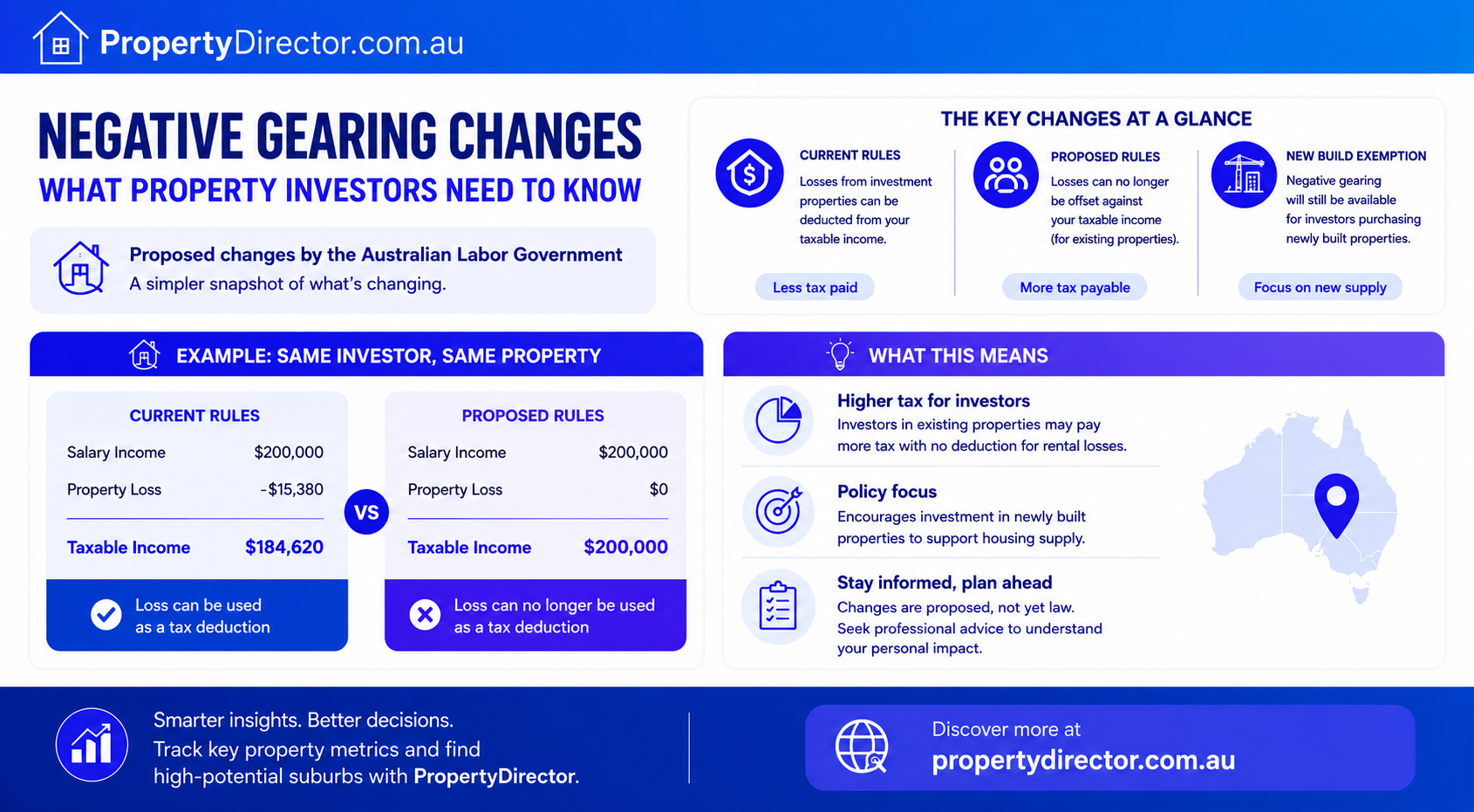
Today, we’re providing a simple overview of the proposed changes to negative gearing being discussed by the Australian Labor Government.
In simple terms, here’s what the proposed negative gearing changes could mean:
• Under the current rules, property investors can generally use losses generated by their investment properties to reduce their taxable income, meaning they ultimately pay less tax.
• Under the proposed rules, investors would no longer be able to offset losses from investment properties against their taxable income.
• The proposed changes would only apply to investors purchasing existing properties. Negative gearing would still remain available for investors purchasing newly built properties.
To help illustrate the potential impact, let’s look at a simplified example below.
CURRENT RULES
• Edward owns an investment property in Victoria that generates $495 per week in rental income. He also pays $3,010 per month in interest-only loan repayments, along with $5,000 per year in property-related expenses.
• Based on this, Edward receives:
– $25,740 in annual rental income
– Pays $36,120 in annual interest repayments
– Pays $5,000 in annual property expenses
• This results in an annual loss of $15,380 on the property, meaning the property is negatively geared.
• Edward also earns a salary of $200,000 per year. Under the current rules, he can use the $15,380 property loss as a tax deduction.
• As a result, his taxable income is reduced from $200,000 to $184,620.
PROPOSED RULES
• Using the same example above, let’s assume Edward’s investment property again generates an annual loss of $15,380.
• Under the proposed rules, Edward would NOT be able to use this $15,380 loss as a tax deduction against his salary income.
• This means Edward would pay tax on the full $200,000 salary, without the benefit of negative gearing.
While these changes are still only proposals at this stage, they could significantly impact future property investment strategies, cash flow planning, and long-term wealth creation for Australian investors.
As always, investors should seek tailored advice before making financial or property decisions.